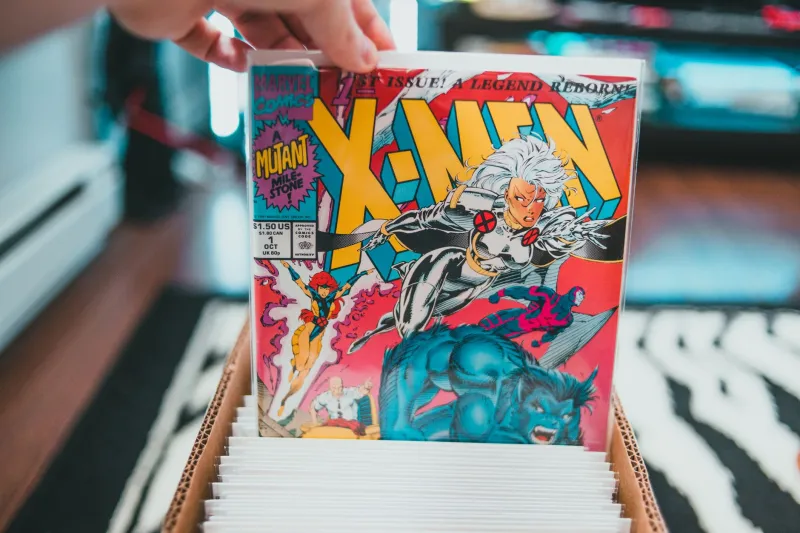
The Best Part of Your Comic Might Be Hiding in the Back
Photo: Kgbo, CC BY-SA 4.0, via Wikimedia Commons
There is a certain kind of comic reader who does not start on page one. They flip straight to the back, past the letters page, past the ads, to the short comic tucked behind the main feature. They know something the rest of us forget: the backup story is where a lot of the good stuff lives.
For everyone else, consider this a friendly reminder. The backup is not filler. It is not a bonus disc. It is one of the best deals in comics, and it has been quietly disappearing from mainstream single issues for years.
What a Backup Story Actually Is
A backup story is a short comic that runs behind the main feature. Usually five to ten pages, sometimes serialized across several issues, sometimes a one-and-done. It is not a new idea. Old EC Comics books packed multiple stories into one issue. Bronze Age superhero books used backups to test new characters and spotlight sidekicks. In 2026, the backup is alive mostly in indie and mid-size publisher books, where a ten-page story can still share space with a twenty-page lead.
The format is simple. The effect is not.
A World-Building Tool Hiding in Plain Sight
Here is the thing about ongoing superhero comics: the main story has to keep moving. There is an event to set up, a villain to escalate, a status quo to protect. That leaves very little room for texture. A backup story can do the texture work without derailing the plot.
Want to show what a city looks like on a Tuesday morning? Backup. Want to give a C-list villain a genuinely unsettling origin? Backup. Want to explain why a supporting character keeps showing up even though she has no obvious role in the current arc? Backup.
The main story stays lean. The world gets bigger. The reader gets two stories for the price of one. That is not nostalgia. That is math.
The Farm Team for New Talent
Backups are also one of the few low-risk ways a publisher can put a new artist or writer in front of an audience. A ten-page story is cheaper than a full issue. It is less exposure for a new creator if the experiment does not land. But when it does land, readers notice.
A lot of working professionals got their first real shot in a backup. Not all of them became superstars overnight, but they got pages. They got a credit. They got a chance to show what they could do with a character they did not create. In an industry that constantly complains about the bench being thin, backups are how you build a bench.
Why Single Issues Feel Thin Without Them
A monthly comic costs around five bucks now. For that money, a reader gets twenty pages of story, a few ads, and the vague promise that the next issue will be better. That is a tough sell when a streaming service costs less than two comics a month and offers an entire library.
A backup changes the value proposition. It makes the single issue feel like a complete object. You get the main chapter and a short film. You get the ongoing plot and a little detour. You get the thing you bought and a thing you did not know you wanted.
That matters more than publishers seem to realize. Readers are not asking for every issue to be a double-sized anniversary special. They are asking for the five dollars to feel like five dollars.
The Case for Bringing Them Back
Backups are not a cure-all. They cost money. They take coordination. They require a publisher to think about the single issue as a package instead of a delivery mechanism for the next trade paperback. But the upside is real.
They can keep schedules alive when the main team needs a breather. They can test miniseries ideas without committing to a full launch. They can give readers a reason to flip to the back of the book and actually read the credits. They can make a monthly comic feel like a magazine again, in the best possible way.
The next time you pick up a single issue, check the back. If there is a backup, read it. If there is not, ask yourself why. The best part of your comic might be hiding back there, waiting for someone to notice.